Wednesday, 9 June 2010

The End of the World...and beyond.

Mother Nature is certainly making up for her parsimonious rainfall rations so far this year, with a very damp start to ‘Flaming June.’

Like the legions of In-ger-land fans bracing themselves for the inevitable early elimination from the World Cup, the reservoirs are in need of large levels of refreshment, so a good downpour is not unwelcome.

I always find that damp and overcast weather is good for walking in the uplands. Sun is the mortal enemy at this time of year as the heat haze can make birding very difficult and the hot conditions can make you sweat like a hung-over Paul Gascoigne in a sauna.

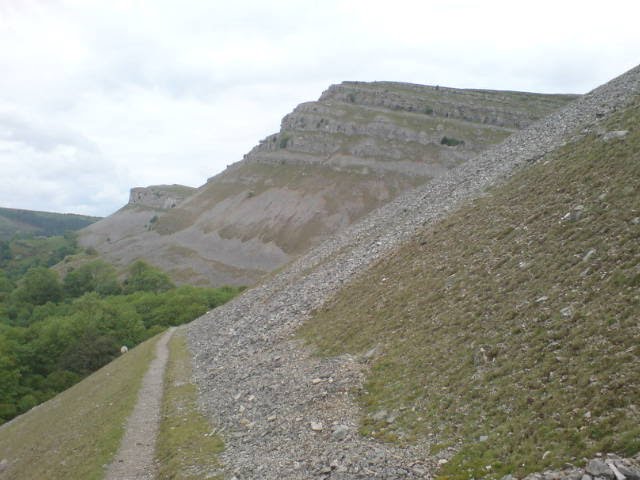
So it was off to Ruabon Moor for one of my favourite walks: World’s End to Rock Farm along the top of the ridge and then back to start via the Offa’s Dyke path.

A lively Grey Wagtail was flittering around the stream on the way up to the top where the border between the wood and the heather was home to two singing Tree Pipits and a male Whinchat.

Nine Crossbill over was good and other finches in the area included Siskin, Linnet and at least one Lesser Redpoll.

Numerous Wheatears dotted the route along the permitted path whilst a pair of loud and frequently calling local residents - whom could probably benefit from being a little more discreet – did their utmost to draw attention to themselves.

The habitat up here looks perfect for Ring Ouzel: scree slopes, boulders and close proximity to water make it very suitable indeed, but I guess declining numbers plus disturbance means areas like this are now largely uninhabited - having said that Denzil had bagged a male up here last week.

Distant calls from Curlew and Raven respectively echoed down the ravine towards Rock Farm, but birds close by were few.

And so it was along the Offa’s Dyke path with one notable exception – Redstarts. Four males on territory on the way back to World’s End, including one mint individual that showed to ten yards from the top of a small Mountain Ash.

World’s End 09.06.10

Curlew 1
Tree Pipit 2
Pied Wagtail 2
Grey Wagtail 1
Redstart 4
Wheatear 8+
Whinchat 1
Stonechat 4
Raven 2
Crossbill 9
Plus, three species of raptor.

Until later.


Monday, 7 June 2010

Spooky Birding

A couple of hours early doors around Frodsham No. 6 tank produced a few goodies, but the most interesting aspect of the walk is pictured above!

The trees and bushes that run for a good couple of hundred metres along the north end of No.6 were absolutely covered in silk and thousands of larvae. It reminded me of the inside of all the haunted houses featured in episodes of Scooby Doo when all the furniture seemed to be cloaked with cobwebs!

I have done a little research on the internet and it looks like the culprit may be the White Ermine Moth (Spilosoma lubricipeda Arctiidea)? It’s fairly common and the larval food plant is right I think (mostly White Poplar)…one hell of an irruption nonetheless.

Also of predominantly white appearance was a cracking Avocet probing the margins of the small pool created last spring by workings to the drier section of number six. They seem annual down here now, albeit in ones and twos. Coming to think of it, I think my first ever Avocet was a pair on the Weaver Bend a few years back.

Not surprisingly there were few butterflies around on such a dreech morning, but I did manage to find my first Painted Lady of the year.

A Cuckoo on number five tank was a nice surprise and it looked to all intents and purposes to be a female scouting for somewhere to deposit an egg – spoilt for choice at the moment!

The last notable bird was a Gropper opposite the airstrip. After peering in the grass looking for the reeling male without success for what seemed like an eternity, another Gropper – perhaps its mate – rather co-operatively plonked itself on top of a fencepost for a few seconds before realising this was madness, and in a blink of an eye it joined the other bird deep in the undergrowth.

Until later.

Friday, 4 June 2010

Good News

I read in dispatches (well a forwarded email by Mark Murphy!) that the RSPB aim to construct a new hide at the Point of Ayr by the onset of winter.

This is great news. I am extremely fond of this site and have spent many a magical hour sat in the old hide – I will never forget the freezing cold autumnal morning when I watched a Marsh Harrier and Pomarine Skua come to blows over the edge of the marsh.

Whether or not this process has been expedited in recent days or that it is just coincidence that this is going ahead now is immaterial, but credit where credit is due, the RSPB is now at least doing something - and importantly informing people what is going on and what its intentions are.

Perhaps, this glasnost will extent to the reserve at Inner Marsh Farm and a little bulletin will be released detailing the chronology of the project and any potential problems they are having or may encounter in the future. Dare I suggest it could even be attached to the back of the toilet door on the new temporary lavatory!!

Anyway, that’s quite enough moaning by me for this week (and year hopefully). I sincerely look forward to my first posting from the new Point of Ayr hide – or should I say ‘viewing facility’ (sorry, that was a bit naughty).

Back to birds and wildlife tomorrow.

Jai Govardhanadhari.

Thursday, 3 June 2010

Remembrance of things past...

Aside from the impasse at Inner Marsh Farm, the hide at the Point of Ayr is still to be replaced. It is about time this situation was resolved, so I have sent an email to the RSPB Head Office with the faint hope of illiciting a response.

As one person, there is very little I can do apart from withdraw my financial support. At around forty folding each year, this is a drop in the ocean, but over the years it adds up.
Here is a copy of the email:
To whom it may concern,

It is now approaching two years since the hide at the Point of Ayr in Flintshire, North Wales was sadly vandalised beyond repair.

Nearly twenty four months hence, there is still no sign of a replacement hide, nor any strong evidence of any positive intention to do so.

This hide was used regularly by a number of local birders and not only was it a physical structure, it was also a place where I met many new people and struck up friendships that still exist to this day.

I understand that any new hide would be prone to vandalism, but surely this problem is not insurmountable – for example a refurbished old steel container would be both robust and provide the necessary shelter from the elements.

It is hard to imagine that had this hide been at Minsmere – or indeed any other major reserve – that it would not have been replaced very quickly. Sadly, this inertia does not surprise me.

I would be grateful, therefore, if you could provide me with some definitive plans as to what is to de done in terms of replacing this hide and when those plans will be enacted.

If these are not satisfactory, then I’m afraid I shall be terminating my membership with the RSPB for good and urging others in the area to do the same. Furthermore, I shall not be supporting the volunteer warden scheme at the Point of Ayr until the hide is replaced.

I also run a blog
http://theblackgrouse.blogspot.com where I shall continue to push this issue and also the frustration with the painfully slow development of Inner Marsh Farm.

Yours etc,

Paul Shenton.
Until later.

Tuesday, 1 June 2010

Keith on the Case

Not much doing at the Point of Ayr this morning as Becks and I were drowned out by heavy rainfall. A drenched Wheatear, plus fledged Stonechats and Common Whitethroats was as good as it got.

Perhaps it is fitting then that I take this opportunity to publish the RSPB’s response to Keith Ducker’s correspondence on the development of Inner Marsh Farm.

Credit to Keith for sticking his head above the parapet and seeking out answers to questions many regular visitors to the reserve have been asking amongst ourselves.

So, in the words of Marvin himself, just what is going on?

Keith’s correspondence:

To whom it may concern? A couple of questions for you:

Why after the RSPB bought more land for above - more than three years plus ago that
there are still no toilet facilities or new hides to be seen?

Is it because the RSPB - Inner Marsh Farm - Burton - Cheshire is based in the North West?
If it was based in the south would it have toilet facilities or new hides? Should there be facilities for the disabled as well?
There are a lot of disabled people interested in birdwatching. Again if it was based in the south - would it have these?

Should there be more bird boxes/bird tables on the reserve to encourage more birds? Not too much to ask for.
We are continually being informed of the great plans for this reserve without anything tangible taking place. What if anything is going to happen to the reserve in the next few months? Is somebody or someone somewhere dragging their feet?
I really feel very strongly about above along with other fellow members whom I know feel the same. I await your reply.
Regards,

Keith Duckers

The RSPB's response:

Hi Keith,

The following email has just been passed forward to us here in the Inner Marsh farm office

Thank you for your interest in the project.

For first hand information you are always welcome to come along on one of our monthly "Burton Mere Walks" where you get a chance to go behind the scenes and find out about the ongoing developments and step-by-step processes involved in transforming such a vast landscape.

After many days of preparation and mowing back in October we had the RSPB's Rotary Ditcher create over 4km of footdrains with a vision of creating ideal conditions for feeding waders and their chicks. The success of this creation was almost immediately realised this winter with 750 pink-footed geese and 2000 lapwing spending their time in this area alone! This spring up to 10 pairs of lapwing nested here.

The reedbed project has continued with now over 10,000 reeds having been planted by our team of hard working volunteers. Large areas of rush were cut back and then the area was flooded to allow the reeds to establish themselves. Many of last years reedlings have already produced seed with some reedlings popping up in open areas away from the planted areas. This winter's bittern was seen on several occasions flying into our developing reedbed whilst just the other day we recorded the 1st ever singing reed warbler in the reed bed.

At present we are awaiting the end of the breeding season to finish before we begin the major habitat creation project. A large area (5 ha) of abandoned arable land will be converted into a wader scrape which will create lots more habitat for wintering wildfowl and waders.

Once this major habitat creation has finished we can commence the construction of a purpose built reception-hide with a wide-angle view over the newly created habitat. Toilet facilities will be provide within the design of this building. Several bird feeding stations are planned as we work hard to bring nature closer.

The access to Burton Mere, reception-hide, nature trails and a number of viewing points around the reserve will be accessible to all. We are hoping to open up the benefits of bird watching and a wider interest in nature to many more audiences including families, people with disabilities and hard-to-reach groups. A large amount of interpretation work is being planned to make the reserve an enjoyable day out for all.

A blog has started up now on our home page detailing some aspects of our work here on the reserve so why not visit
www.rspb.org.uk/innermarshfarm feel free to read and contribute your thoughts and bird sightings.

I hope that we have helped to alleviate some of the queries of your friends and yourself.

If you have any more question then please do not hesitate and just ask a member of staff or volunteer.

Regards,

Paul Brady
Visitor Development Officer
RSPB Dee Estuary


Well, make of that what you will - hardly a satisfactory response to Keith’s letter in my opinion.

In fairness, lots of work has gone in to the planting of the reedbed and the development of the new wetland meadow – both superb new areas of habitat that hopefully members will be in a position to enjoy fully in the future. The new scrape should be excellent too.

However, it is unacceptable that no provision has been made in recent years for members wishing to use the toilet. It does not take much effort to provide a portaloo - or something similar - until the RSPB is in a position to provide permanent facilities.

Moreover there is no acknowledgement of a delay in the work being carried out, any reasons put forwards for the delay, or perhaps more crucially any indication of when the project will be completed. In my view, this is where the RSPB have gone wrong – a few paragraphs in the hide detailing where the work is and outlining any current or potential problems would go along way.

Of a wider concern to me – and it is becoming more apparent – is the general nature of the RSPB and its tone. Large parts of the above text are just meaningless corporate jargon that has clearly been culled from some organisational document. What does ‘work hard to bring nature closer’ mean and who are ‘hard to reach groups’ precisely – people with no interest in nature?

In my opinion the RSPB should quite simply stick to managing nature reserves for the benefit of the people who visit them – us, the people who cough up our memberships. No gibberish, just plain and simple conservation for birds with the means to be able to watch and enjoy them in comfort.

Until later.