Showing posts with label Point Of Ayr. Show all posts

Tuesday, 7 September 2010

Four Hundred Swallows does make an Autumn

With news that a Stone Curlew had been sent packing from Hilbre in the direction of Wales, in a bout of ludicrous optimism I was up early this morning for a good scout around the dunes at Talacre.

And what did I find? Well, alas no Eurasian Thick-knee, but plenty of warblers – Blackcaps mostly – and a very good passage of Swallows that continued unbroken all morning.

After a couple of hours of a diet of Chiffchaffs, Willow Warblers, Common Whitethroats, and the aforementioned Blackcaps, I decided I wasn’t going to bag a Wryneck or a Barred Warbler and elected to walk down to the old hide area to watch the tide come in.

As expected, the Kingfisher was present and correct, but my attention was drawn to the end of the spit where the amassing Oysties were being terrorised by a rather inept juvenile female Peregrine.

Things had settled down by the time I had plonked myself on hte bench. Excellent numbers of Curlews today, possibly in excess of two thousand birds – a great count down here.

Other waders included singles of Whimbrel, Black-tailed Godwit, Greenshank and Knot and these were soon joined by a score of winter liveried Bar-tailed Godwits spare a couple of moulting adults.

For the final hour I moved over to the spit and found a hundred or so Ringed Plover, plus thirty Dunlins roosting on the shingle, whilst over the drink there was little save a handful of Sandwich Terns, a Gannet and a Grey Seal.

Point of Ayr 7.9.10

Curlew circa 2,000
Oystercatcher circa 2,500
Ringed Plover 100
Conwy Sandpiper 30
Bar-tailed Godwit 20
Black-tailed Godwit 1
Whimbrel 1
Greenshank 1
Knot 1
Redshank 80
Peregrine 1 (juvenile female)
Sparrowhawk 2 (juvenile female and an adult female)
Sandwich Tern 6
Gannet 1
Great Spotted Woodpecker 2
Kingfisher 1
Blackcap 10+
Common Whitethroat 3
Chiffchaff 4
Willow Warbler 3
Bullfinch 2
Wheatear 3
Swallow 400+

On a different tack, I could write thousands of words on what I feel about the direction the RSPB is heading, but in a glorious piece of serendipity this little quote from RSPB Starbuck’s website sums it up for me much more succinctly than I ever could:

“My husband and I often visit on a Saturday afternoon. It's a real treat. There's always something interesting to see at this lovely spot and the coffee, cakes and view (sic) from the cafĂ© are just great. “ Jane Turner

Until later, or hasta luego – off to Spain again for a short break!!

Thursday, 2 September 2010

Odds and Sods

It’s been fairly quiet down at the Point of Ayr this week. The exception being a Kingfisher that has taken up residency on the pool next to the path that leads to the old colliery site.

The water looks grim, and resembles a smaller version of the uber-polluted lakes that you used to see in next to chemical plants in some poor ex-Soviet bloc satellite country.

Still, it seems fairly content there, although it is often buried right at the back of a cluster of dead branches – almost as if it is slightly ashamed to be fishing in such a dirty pond.

The odd Wheatear on the seawall past the old hide, plus a few common warblers have been the only signs of passerine migration, although on the wader front I did catch up with a group of circa three hundred Ringed Plover feeding on the mud yesterday when out gathering some Marsh Samphire.

General wader numbers seem to building, and also the first Pintail and Wigeon have returned to the Point – both species before August was out.

Until later.

Sunday, 29 August 2010

Great Expectations

A brisk north-westerly had me hunkered down in the dunes at Talacre late morning anticipating a decent seawatch.

After a frustrating half an hour watching a handful of distant Shearwaters, the first of what was to be two Bonxies powerfully lumbered out of the estuary fairly close in.

This was quickly followed by a dark-phase Arctic Skua that after a rather half-hearted attempt at flying into the wind ‘flopped’ down on the sea near a large buoy.

Then, after a barren spell a conundrum. It was another Skua that initially I had down as a juvenile dark-phase Arctic, but on closer inspection it appeared to be a bit more beefy and that nudged me towards a young Pomarine…will just have to leave that one…

Another hour must have slipped away watching squillions of terns and a drip feed of Gannets before the first Fulmar of the day moved through prompting a small movement of juvenile Kittiwakes.

After yet another funk, Great Skua number two, but try as I might, no Petrels, and considering the conditions a tad disappointing.

Will be interesting to see if anybody had any Petrel joy over in the Wirral – not much seems to slip past unnoticed at Hilbre!

Point of Ayr 29.08.10

2 Great Skua
1 Arctic Skua (dark phase, adult)
1 Arctic/Pomarine Skua (dark, juv)
20+ Gannet
15+ Kittiwake (mostly juveniles)
1 Fulmar
1 GC Grebe
4 Guillemot
1 Razorbill
1 Wigeon (first of 'autumn')
Lots, and lots, and lots of Terns.

Until later.

Tuesday, 24 August 2010

So-so.

With strengthening ‘westerlies’ confidently predicted by the Beeb, I chanced my arm for a couple of hours seawatching down at the Point of Ayr this morning.

Unfortunately both flags near the car park were intent on telling a slightly different tale, with the blow coming from a more south-westerly direction – not ideal.

Things kicked-off pretty well though, with four juv/fem Eider floating along the shoreline with the prevailing wind. Only the second time I have bagged Eider down here, after my first – a Drake – was just last autumn.

Had I have known that this was as good as it was going to get I would have packed-up after ten minutes, but the constant stream of terns kept my attention if not interest.

Whilst a fair few Gannets flew fairly close to the beach, the Skuas – if there were any about – were not playing ball. The only sniff I had was of a large Skua-type silhouette moving distantly across the horizon.

Also, mere dots were a couple of Manxies, a Kittiwake and a few groups of a score or so Common Scoter. With Liverpool Bay having just been given special protection http://www.bbc.co.uk/news/uk-england-merseyside-11031671 I would have assumed the Scoters would have been strolling along the beach puffing in cigars rather than toughing it out in strong winds!

With an hour or so to spare there was just enough time to check-out the high tide roost from the old hide area. Try as I might, I could not winkle one Med Gull out of the hundreds of roosting Black-heads; I just can’t seem to bag one in Flintshire this year.

It was scanning through the Mallards though, that the surprise birds of the day appeared: three very early female Pintail – I don’t think I have ever seen the first ‘winter’ arrivals in August before…

4 Eider
60+ Common Scoter
1 Kittiwake
2 Manx Shearwater
30+ Gannet
250+ Sandwich Tern
40+ Little Tern
1 Arctic Tern, plus several ‘Commic.’
2 Ringed Plover
3 Pintail
500+ Curlew

Until later.

Monday, 23 August 2010

Make it Snappy

After getting up ten minutes before going to bed on Sunday morning to attend a car boot sale, I was wide awake at six thirty this morning. Puffing my pillow, rolling over and closing my eyes would have been the sensible option, but instead I was possessed by another entity that coerced me out of my warm bed and no more than ten minutes later into the car and heading down to the Point of Ayr.

Not much doing on the marsh so I opted for a trek through Talacre Dunes and up to Gronant. It was fairly quiet with a few Stonechats and a Bullfinch, plus a steady trickle of Swallows.

The loud calling of a Whimbrel then attracted me to a trio flying high over the dunes in an easterly direction – no surprise considering there as been quite a few reports of ‘Whimbrel en route’ across North Wales this weekend.

Gronant beach was bereft, but there was a mummified fossil of the head of a saltwater crocodile that had been washed up on the shoreline (see above)!

Returning back through the dunes I headed over to the small wood behind the horse paddocks where fortunately I bumped into a mixed flock of fifty or so passerines working their way through the vegetation.

Completely ignoring me, I was able to observe the birds at fairly close proximity as they methodically scoured the twigs and branches for food. Almost all juveniles, the flock contained Blackcap, Common Whitethroat, Willow Warbler, Chiffchaff, plus Long-tailed, Great and Blue Tits.

On another note, there are still hundreds and hundreds of waders on the bunded pools at Connah’s Quay NR – a spectacular spectacle. On Saturday there was in excess of fifteen hundred Blackwits with about a dozen Greenshank and four Spot Reds including one in near full summer plumage.

Until later.

Thursday, 12 August 2010

Hola, Hola, It's Good to be Back

Well, the old internet is finally up and running!

I had forgotten how difficult this writing malarkey can be sometimes, so I’m not sure where to start. I suppose today is as good as any.

With the wind from the north west it was probably a good idea to do some seawatching from the Point Of Ayr today. Henceforth, I did precisely the opposite and sauntered up to the site of the old hide and back over the high tide.

Plenty of Sandwich Terns were screeching around, but probably most notable was the large number of Oystercatchers that are starting to build up – I have seen them reach formidable numbers here in early autumn.

Minus telescope there wasn’t much scope (sorry, bad pun), for picking out anything unusual, but with the sun shining on my back and an abundance of butterflies at large it was one of those occasions to sit on the bench and feel like a king.

Incidentally, one Grayling on the path today – never seen them down here before, but them again I have never looked until this year!

On another thread, it is worth mentioning that Connah’s Quay is particularly good at the moment with big numbers of waders using the bunded pools – something that regrettably isn’t always the case.

Wont be too long before the Black-tailed Godwit flock reaches its full compliment down at Oakenholt. Catching them all in flight from the west hide at high tide is to me the quintessential birding experience on the Dee and there isn’t too long to wait!

Until not as long as last time.

Friday, 4 June 2010

Good News

I read in dispatches (well a forwarded email by Mark Murphy!) that the RSPB aim to construct a new hide at the Point of Ayr by the onset of winter.

This is great news. I am extremely fond of this site and have spent many a magical hour sat in the old hide – I will never forget the freezing cold autumnal morning when I watched a Marsh Harrier and Pomarine Skua come to blows over the edge of the marsh.

Whether or not this process has been expedited in recent days or that it is just coincidence that this is going ahead now is immaterial, but credit where credit is due, the RSPB is now at least doing something - and importantly informing people what is going on and what its intentions are.

Perhaps, this glasnost will extent to the reserve at Inner Marsh Farm and a little bulletin will be released detailing the chronology of the project and any potential problems they are having or may encounter in the future. Dare I suggest it could even be attached to the back of the toilet door on the new temporary lavatory!!

Anyway, that’s quite enough moaning by me for this week (and year hopefully). I sincerely look forward to my first posting from the new Point of Ayr hide – or should I say ‘viewing facility’ (sorry, that was a bit naughty).

Back to birds and wildlife tomorrow.

Jai Govardhanadhari.

Thursday, 3 June 2010

Remembrance of things past...

Aside from the impasse at Inner Marsh Farm, the hide at the Point of Ayr is still to be replaced. It is about time this situation was resolved, so I have sent an email to the RSPB Head Office with the faint hope of illiciting a response.

As one person, there is very little I can do apart from withdraw my financial support. At around forty folding each year, this is a drop in the ocean, but over the years it adds up.
Here is a copy of the email:
To whom it may concern,

It is now approaching two years since the hide at the Point of Ayr in Flintshire, North Wales was sadly vandalised beyond repair.

Nearly twenty four months hence, there is still no sign of a replacement hide, nor any strong evidence of any positive intention to do so.

This hide was used regularly by a number of local birders and not only was it a physical structure, it was also a place where I met many new people and struck up friendships that still exist to this day.

I understand that any new hide would be prone to vandalism, but surely this problem is not insurmountable – for example a refurbished old steel container would be both robust and provide the necessary shelter from the elements.

It is hard to imagine that had this hide been at Minsmere – or indeed any other major reserve – that it would not have been replaced very quickly. Sadly, this inertia does not surprise me.

I would be grateful, therefore, if you could provide me with some definitive plans as to what is to de done in terms of replacing this hide and when those plans will be enacted.

If these are not satisfactory, then I’m afraid I shall be terminating my membership with the RSPB for good and urging others in the area to do the same. Furthermore, I shall not be supporting the volunteer warden scheme at the Point of Ayr until the hide is replaced.

I also run a blog
http://theblackgrouse.blogspot.com where I shall continue to push this issue and also the frustration with the painfully slow development of Inner Marsh Farm.

Yours etc,

Paul Shenton.
Until later.

Thursday, 27 May 2010

Event Horizon

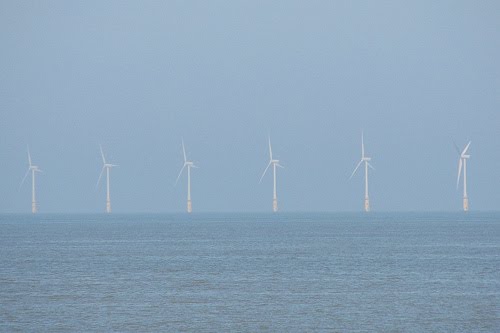
A handful of Little Terns, and a distant and unidentifiable Skua was all there was to amuse me whilst seawatching at the Point of Ayr this morning and I was about to pack it in when I caught site of a very large bird circling high above the wind turbines a couple of miles out to sea.

After eventually training my scope on the bird my initial impression was of a very big raptor. It was difficult due to the heat haze and the distance to make out much detail, but I watched it for a good ten minutes as it repeatedly soared, drifted and then soared again towards the Lancashire coast.

I could, however, just make out the large broad wings when the bird banked, and my general impression was of a dark silhouette of large Eagle. I quickly ruled out a large Gull due to the flight style and the lack of a protruding neck and head seemed to eliminate a Crane or a Stork, but again, the jizz of the bird didn’t seem right for these species either.

Definitely a very interesting bird, although I’m not going to get to carried away speculating on the identification of a bird from the best part of two miles away – tantalisingly close nevertheless…It will certainly be interesting if anything of this ilk is picked-up nearby by somebody else today, but as I have just gathered most eyes will be trained on a White-tailed Lapwing at Seaforth!

Point of Ayr 27.5.10

1 Eagle (sp)?
7 Little Tern
1 Guillemot
1 Skua (sp).

Until later.

Thursday, 29 April 2010

The day of the Wheatears

Light south-westerlies overnight coupled with the outbreak of rain early doors, produced an excellent fall of migrants at the Point of Ayr this morning.

As was the case a week last Monday, Wheatears were legion. The birds - grouped in flocks of ten to twenty - were concentrated around the area to the east of Presthaven Sands and also on the rocks near the old colliery site.

It is only a guestimate, but I counted a mighty one hundred and seventeen during a two hour walk, by far my highest count for a single site – smashing last week’s record to smithereens!

Two male Whinchats were good to find too, but star bird of the day was my earliest ever Spotted Flycatcher in the row of trees leading to the old hide. I really struggled to find one anywhere last year, so it was gratifying not only to discover my first for Flintshire, but see on at all – they really have crashed dramatically in recent years.

Plenty of warblers around too, with Sedgies the most conspicuous - singing from all types of habitat except sedge seemingly! Plenty of Chiffchaff, Whitethroat, Blackcap and Willow Warblers in voice too, and more warblerly calls eminating from the many dense hawthorne bushes, indicated a fair few more.

There seem to be very good numbers of Wheatears passing through this year - last Monday sixty three were at the POA and I have had big numbers in the uplands this spring too, including thirty seven during one walk in Mynydd Hiraethog.

I only have four years of personal experience to draw upon, but these numbers seem exceptional, so I am interested to hear if anybody else has had good counts this year...

Point of Ayr 29.4.10

Wheatear 117
Whinchat 2 (both male)
Spotted Flycatcher 1
Sedge Warbler 6
Common Sandpiper 1
Greenshank 1 (over)

Until later.

Sunday, 25 April 2010

Old Haunts

With lightish southerly winds and rainfall early doors, I headed over to the Point of Ayr in anticipation of a decent flush of migrants.

As I entered Talacre a showy Tree Pipit suggested early promise, but any hopes of a decent fall soon evaporated as I walked further into the dunes. Three Wheatears and four Common Whitethroats was as good as it got and with the numbers of dogs and people increasingly looking like Crufts meets the Kumbh Mela, I headed for the sanctity of Garth Wood.

Eerily quiet for late April, things soon picked up when I heard a male Pied Flycatcher singing further up the path. When I got close to where it was scratching away, I realised it was from the precisely the same spot that I had seen a male bird last year!

I watched it for a good fifteen minutes, but with the bird retreating higher and higher up into the canopy, I left it to keep working on attracting a lady.

The area of farmland behind Garth Wood had been extremely productive for Yellowhammers last year, but worryingly they are absent this spring, despite yards of suitable hedgerow.

With a spare hour remaining, there was just enough time to pop into Connah’s Quay on the way back. Around a hundred Blackwits were feeding on the edge of a retreating tide and six Wheatears flitted around the surrounding sheep fields.

The bunded pools were largely empty, but a quartet of cracking Greenshanks made up for the absence of any other birds.

Until later.

Monday, 19 April 2010

We're on the move...

Migration finally got underway apace today, with excellent numbers of passerines and hirundines at the Point of Ayr this morning.

Wheatears were everywhere; in the Talacre Dunes, in the horse paddocks near Presthaven and all over the old colliery site. Sixty three birds this morning – my highest count ever for a single area. Superb.

Sharing a grassy fenced-off section with a pair of Wheatears near the entrance to Presthaven was the bird of the morning – a cracking male Whinchat, a first for the year.

After checking the constant stream of Swallows and Martins for anything unusual I was treated not to a red rump, but a completely different silhouette – my earliest ever Common Swift!

A gropper reeling from some scrub was the next bird of note, but a scan across every blade of grass and every fence post in the horse paddocks for a Ring Ouzel or a Yellow Wagtail drew a blank.

With father time jabbing me firmly in the shoulder blade, a quick look around the new (or old as it should have read -thanks Mark!)** hide produced a Whimbrel and another good flypast from what seems to be the resident jack Merlin.

Point of Ayr 19.4.10

63 Wheatear
1 Whinchat
150+ Meadow Pipit
200+ Swallow
200+ Sand Martin
1 House Martin
1 Swift
1 Whimbrel
1 Merlin (male)
2 Kestrel
1 Grasshopper Warbler

Until later.
** By the way Mark, I bumped into the BHP Land Manager at the Point of Ayr on Tuesday and she said that the RSPB and BHP were just about to decide who is going to apply for planning permission for a replacement hide - 21 months and counting.

Wednesday, 31 March 2010

When The Wind Blows...

The first strong north westerly blow for a while had me in the motor and over to the Point of Ayr to indulge my proclivity for seawatcing.

The wind probably in the realm of 35 knots and the there was a fair amount of sleet too, but there is a lovely sheltered spot on the dunes behind the lighthouse and after no time at all I was hunkered down as snug as a bug.

Seawatching is my favourite ‘type’ of birding, although I know it is not everybody’s cup of tea. As somebody once famously said “Work, I am fascinated by it. I could sit watching it for hours”, well this holds true for me and the sea. Even if there are few birds I could quite contentedly sit observing the ocean for ages – especially like today when it was very angry.

There were a few bits and bobs today, but for volume of birds it was fairly disappointing. Ten Kittiwakes went past over the couple of hours I was there and later on a couple of Fulmar flew through. Bird of the day though was a Sandwich Tern looking hopelessly frail and just about ready to snap in two as is valiantly attempted to fly out of the estuary into the strong gale – my first this year too.

A pair of Red-breasted Mergansers and three Common Scoters was the only wildfowl recorded, and on the wader front quite a few Grey Plovers seemed to be passing through.

Incredibly, not one, but two people were out walking in shorts today - and one of those wasn't even WAO!

31.3.10 Point of Ayr Seawatch (10:45 – 12:45)

1 Sandwich Tern
2 Fulmar
10 Kittiwake
2 Red-breasted Merganser
3 Common Scoter
100+ Grey Plover

Until later.

Thursday, 25 March 2010

Just Passing By...

Nothing stirs the soul more than the sight of some good visible migration, even if the hundreds of birds conducting the combined ground and air invasion of Talacre Dunes this morning were practically all humble Meadow Pipits.

It is hard to quantify precisely how many there were, but a conservative estimate would be 600 plus, whilst a widely ambitious forecast (I will call that a labour estimate) would be in excess of one thousand. A liberal approximation would probably be about correct, but I assume you have stopped listening now.

There were a few other species knocking about, most notably ten Wheatears behind the lighthouse - including eight on one single bush. A few Zilpzalps provided some background music, although they were mostly drowned out by the wheezing Greenfinches.

Buoyed by a decent fall I headed over to check the old colliery site where I was greeted with another four Wheatears, a pair of Stonechat and yes, you guessed it, even more Meadow Pipits.

Also probably just passing through was a rather scruffy looking male Merlin (Merlin Haggard? (one for C&W fans)), that was probably thanking its lucky stars at the steady stream of breakfast entrees passing before its very eyes!

On the way back home there was just enough time to pop into Connah’s Quay, where I bumped into Cohen Senior and KLJ. Scanning through the logbook, I was lamenting the lack of Twite on my radar this winter – especially as two flocks of forty and twenty birds had been seen only this week.

Someone was clearly listening up there today, because no more than a minute later a flock of eight birds was dispatched towards the west hide. After a quick bath in the stream they were off flying over the Dee and towards the marsh – Krishna must have been in a playful mood today!

Point of Ayr 25.3.10

Meadow Pipit – many
Wheatear 14
Merlin 1
Skylark 30+
Stonechat 2

Connah’s Quay NR

Twite 8
Wheatear 2

Until later.

Monday, 15 March 2010

Jack the Lad


Desolation best described Talacre this morning, with the paucity of birds and biting westerly blow making for a miserable walk.

A couple of Grey Plovers and a quartet of Sanderling was the best of slim pickings on the windswept beech, whilst the dunes hardly fared better with the sum total of a Reed Bunting, a few Skylarks and a pair of Meadow Pipits.

With the tide reaching its peak, I decided to walk up to the old hide along the edge of the marsh. At last – some birds, albeit pretty modest numbers of Oystercatchers and Curlew roosting on the spit - the wader roost seems to have really dropped off at the Point of Ayr over the last month.

Then, from absolutely nowhere a stunning male Merlin zoomed across the path no more than ten metres from me. It headed along the bank behind the pool that lies shilded by line of trees, before alighting on a post no more than twenty yards from where I was stood. The bird looked in superb nick and I watched it perched for a good fifteen minutes before it flew off towards the dunes.

Jacks, like adult male Hen and Marsh Harriers are unusual on the estuary and based on my personal observations over the last five years there appears to be a heavy bias towards female and juvenile raptors in relation to many species.

I have mentioned this to a few people, but I soon discovered that nothing makes peoples’ eyes glaze over more quickly than me bringing up this half-baked theory! Still, I do think there is something in it and if I was a budding Ornithologist looking for a dissertation subject, then this would be it!

As if to add credibility to my premise, a ringtail Hen Harrier popped up from the marsh before quickly dropping down out of sight again. This seemed to alarm a few Redshanks, but the Harriers presence didn’t ruffle any of the feathers of the larger birds.

With the raptor opting to stay out of the wind, I had a quick scan through the rafts of Shelduck that turned out to be harbouring four Red-breasted Mergansers and a single female Goldeneye.

Point of Ayr 15.03.10

1 Merlin (Jack)
1 Hen Harrier (ringtail)
1 Kestrel
750 Oystercatcher
500 Curlew
4 Red-breasted Merganser
1 Goldeneye

Until later.

Monday, 1 March 2010

Thermal Imaging


With bright and warm sunshine it felt as if spring had finally arrived down at the Point of Ayr this morning. Despite the relatively high pressure and benign conditions, the tide absolutely stormed in before lunchtime, completely consuming the marsh – spring weather and spring tides to match!

As a whiskey-soaked old sea dog that I met in Seattle once proclaimed after reading about two people drowned in nearby Puget Sound “Only a fool or a newcomer predicts the tides in Seattle” – seems this mantra holds true for Clwyd too!

A Little Gull migrating eastwards early morning was the first cast-iron evidence that birds are finally on the move. When I first picked-out the tiny larid a good way offshore, the bouncy flight and lack of perspective made the bird initially look like a gigantic tern! However, I quickly came to my senses when it veered towards land iand fluttered past a much bigger Herring Gull. An adult, the bird was in near full breeding plumage.

More possible evidence of migration included a pair of Golden Plover on the beach early morning – unusual birds here – and perhaps more credibly a brace of flyover Curlew. I first locked onto the birds flying high and directly at me from the direction of the Isle of Man. Rather than looking to settle on the beach, the waders gained even more height and then flew directly over Talacre dunes before heading inland. Perhaps - like the plovers - they were returning to their breeding territories up in the hills. Both of these species of shorebird are, after all, early nesters - but who knows...

Other birds of out to sea included a couple of Red-throated Divers and just visible a Great Northern Diver – but as a hippie might say after a particularly agreeable acid trip, it was far, far, out.

God’s own side of the Dee Estuary was far from finished with providing interesting birds though. As I was walking to the location of the old hide, a big raptor came into view flying low over the gas plant. With the first warm day for weeks, I imagined it was probably a Buzzard enjoying some long overdue thermals. Happily I was wrong – it was a superb Red Kite – only my second ever for the Dee Estuary and a much prized addition to my Flintshire odyssey.

Again it is only conjecture, but a wandering Red Kite at this time of year could be a bird seeking out a new territory, although they are of course notoriously reluctant to budge far from where they were originally raised - Godspeed I say!

Point of Ayr 1.03.10

1 Red Kite
1 Great Northern Diver
2 Red-thoated Diver
3 Great Crested Grebe
15+ Common Scoter
2 Little Gull
2 Red-breasted Merganser

Until later.

Saturday, 13 February 2010

Silent Witness

No, not an advert for the perils of eating too many salty snacks full of saturated fats, but the rather macabre remains of a Red-throated Diver found on the spit at the Point of Ayr this morning. Birds must perish all the time – especially those subject to harsh conditions out at sea – but this was a sad spectacle as it appears to have lost its left leg.

It is only speculation but I suspect the leg may have been torn off after being caught in fishing nets. This would have severely hampered the diver’s ability to fish and not being able to feed it would have quickly succumbed to starvation.

I was down on the beach for another stint of wardening - this time with local birder Pete Milner. Like many birders I feel duty bound to try and put something back when at all possible. Whether it be doing some survey work, protecting a wader roost or just enthusing people about wildlife – every little helps!

A herd of circa 600 Curlew was the most significant piece of bird news today; these large waders are early nesters so it will not be too long before some return to their breeding grounds.

Otherwise the spit was quiet. Even the Oystercatcher numbers have dropped off with only approximately a thousand today, whilst the remainder of the cast where made up from small numbers of Shelduck, Pintail, Teal, Redshank, Sanderling and Grey Plover.

The resident female Merlin seems to have done a bunk too, although the remains of yet another bird nearby – a dead Skylark – hinted at a recent visit from the diminutive falcon.

Until later.